
You step into the hallway at 5:40 in the morning and your sock is wet.
Not damp. Wet.
You stand there for a second trying to make it make sense. The dog didn’t do it. Nobody spilled anything. You look down the hall and the baseboard has a dark line across the bottom of it that wasn’t there last night.
That second of confusion is the most expensive second in the whole event. Not because of what the water is doing. Because of what most people do next, which is go find a towel.
Put the towel down. Here’s the order.
Minute 1 to 3. Kill the water.
Water damage is a math problem. Gallons times minutes. You can’t change the gallons per minute. You can absolutely change the minutes.
Start at the fixture if you can see it. Under the sink, behind the toilet, there’s a little oval or football-shaped handle on the supply line. Turn it clockwise until it stops. If it’s a quarter-turn valve, it’s a lever, and a quarter turn does it.
If you can’t see the source, or the valve spins without doing anything, go to the main.
Your main shutoff in Queen Creek is usually in one of three places. In the ground near the street in a plastic or concrete box with a lid, next to the meter. On the side of the house near the hose bib, usually the side facing the street. Or in the garage on newer builds where the plumbing runs through the wall.
If it’s the box by the street, you may need a meter key. A long screwdriver and some patience works in a pinch. The valve is a straight bar. When the bar is lined up with the pipe, water is on. When it’s crossways to the pipe, water is off.
Go find that box today. Not during. Today. I’ll come back to that at the end.
If the water is hot, shut the water heater off too. Gas valve to pilot, or breaker off. A water heater that keeps firing with no supply is a second problem you don’t need.
Minute 3 to 5. Electricity.
Water on the floor and outlets on the wall are four inches apart in most homes.
If water is running down a wall, near an outlet, near a panel, or coming through a ceiling with a light fixture in it, kill that circuit. If the panel itself is wet or you’d have to stand in water to reach it, do not touch it. Get out and call an electrician or the fire department. That’s not being dramatic. That’s the one part of this where the house is not the thing at risk.
Minute 5 to 10. Take pictures like you’re going to need them.
Because you might.
Video first, phone in hand, walk the whole thing. Say out loud what you’re seeing and what time it is. Then stills. The wet floor. The baseboard. The ceiling stain. The wall the water is coming out of. The valve you turned off. Anything on the floor that got wet.
Do this before you move a single thing. Then move things. Get furniture legs up on foil or blocks. Pull the rug off the tile. Get the boxes off the garage floor. Lift, don’t drag.
Then take pictures again after.
Nobody regrets having too many photos of their own floor.
Minute 10 to 20. Don’t start demo.
This is the part I care about most, and it’s the part people fight me on.
You want to pull the baseboard off. You want to cut a hole in the drywall and see what’s back there. You want to rip up the carpet pad because it squishes and that feels like doing something.
Stop.
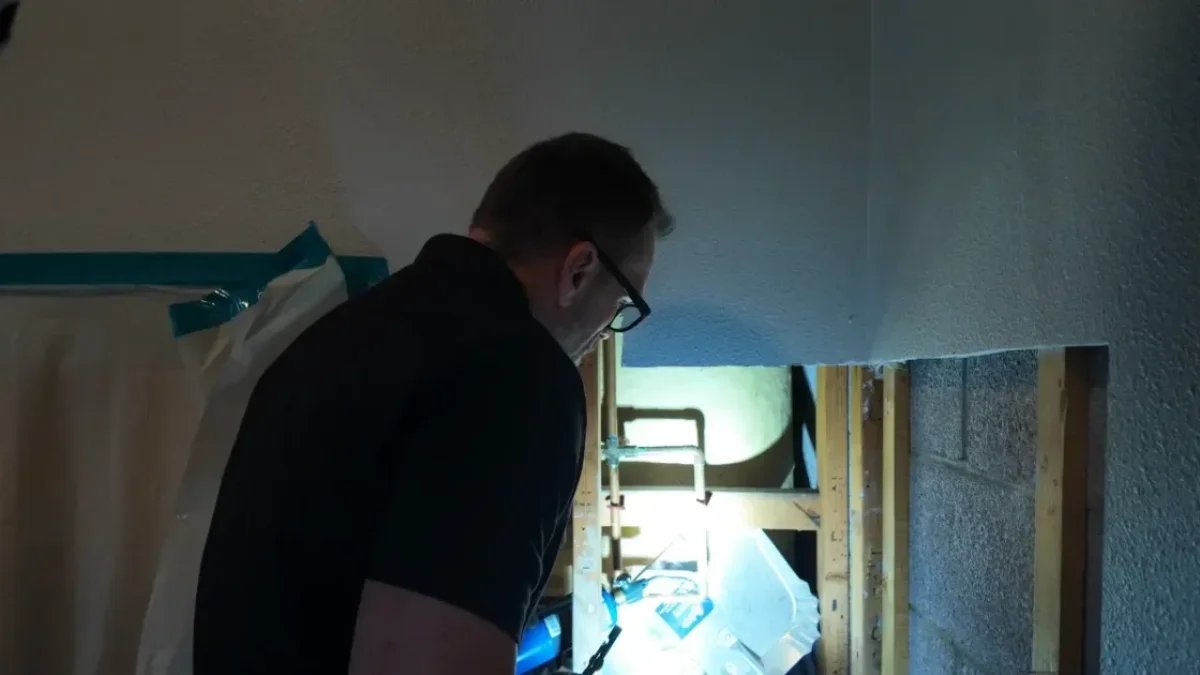
Maria called us out of the Rittenhouse area for an active leak behind her tub. Copper line, pinhole leak. Not a burst. A pinhole. The kind that had probably been weeping for a while before it announced itself.
Her house was old enough that when we tested, the material in the work area came back positive for asbestos.
If she had gotten in there with a utility knife the night before, she would have put fibers into the air of the house she and her family sleep in, and turned a plumbing repair into something a lot bigger and a lot worse. Instead we did the abatement properly, fixed the copper, dried it, rebuilt it. Three weeks start to finish and she’s back in her house.
That’s not a scare story. That’s just Queen Creek having homes from a lot of different decades sitting a few miles apart. The stuff going up off Combs and Meridian right now is not the same house as the older places closer to the town core. You don’t always know which one you’re standing in.
So don’t open anything up. Twenty minutes of not knowing is cheaper than a week of wishing you hadn’t.
Minute 20 to 30. Call, and then get the extent before you get a claim number.
Here’s the part most people in my line of work won’t say in public.
Most people, standing in that hallway at 5:40 in the morning, call their insurance company first. It feels like the responsible move. And a lot of the time it is the wrong first call.
You don’t know what you have yet. You don’t know if it’s a fifteen hundred dollar repair sitting under a two thousand dollar deductible. You don’t know if it’s covered at all. What you do know is that a claim is a permanent thing on your record, and it can follow you at renewal even when it pays out nothing.
Find out what you’ve got. Then decide.
And the second half of that opinion, which is going to annoy some of my competitors. Most restoration companies do not have emergency plumbers on staff. They dry. They can’t fix. So they come out, set fans, and then you’re calling a plumber separately, waiting on a separate schedule, while the fans run and the clock runs and the invoice runs. The water is still coming from somewhere the whole time.
We do both. Plumbing and restoration under one roof. That’s the entire reason the company is named what it’s named. On Maria’s job that meant one crew, one timeline, and a leak that got stopped the same day it got found instead of the day the plumber had an opening.
Why 30 minutes here isn’t 30 minutes somewhere else
Two things about this town specifically.
First, the heat. From May through September your attic runs well past what most people would guess, and the air in this valley is dry enough that a wet wall looks dry on the surface long before it is. Water moves down and sideways into the bottom plate, into the insulation, into the pad. The surface fools you. The inside doesn’t dry on its own. It sits, warm and dark, and warm and dark plus wet is how you get mold in a couple of days instead of a couple of weeks.
Second, monsoon. Every year, roughly July into September, we get storms that dump an inch in forty minutes and drop trees on Ellsworth and Ocotillo. Those are the days when every restoration truck in the East Valley is already committed by 9 a.m. If your leak happens on a monsoon Tuesday, response times across the whole industry stretch. Not because anyone is slacking. Because there is a finite number of trucks and everybody’s roof failed at once.
Add the hard water. It’s rough on copper out here, and pinhole leaks in supply lines are not rare. Maria’s wasn’t unusual. It was Tuesday.
Add the soil. Caliche under a lot of these lots means water that gets under a slab doesn’t drain the way people assume. It goes where it wants.
None of that is generic Arizona talk. That’s why the first half hour matters more here than it would in a basement in Ohio.
The one thing to do today
Go outside right now, while nothing is wrong, and find your main water shutoff.
Open the box. Look at it. Take a picture of it with your phone. Confirm the valve actually turns, because a lot of them out here haven’t moved in fifteen years and are seized solid. Buy a meter key, they’re about ten bucks at any hardware store on Ellsworth, and put it in the garage where you’ll find it in the dark.
Then text that photo to your spouse, your kid, your tenant, your property manager. Whoever is going to be standing in that hallway at 5:40 in the morning when you’re not home.
That’s it. That’s the whole homework assignment.
Five minutes today buys you twenty-five minutes then. And in this, minutes are the entire ballgame.
If you want a second set of eyes on something you’re already worried about, a stain that keeps coming back, a wall that feels cool for no reason, a water bill that jumped without explanation, ask. Finding out what you’ve got is not the same as filing a claim, and you should know which one you’re doing before you do it.
Danjee Moser owns Gateway Plumbing and Restoration in Queen Creek.