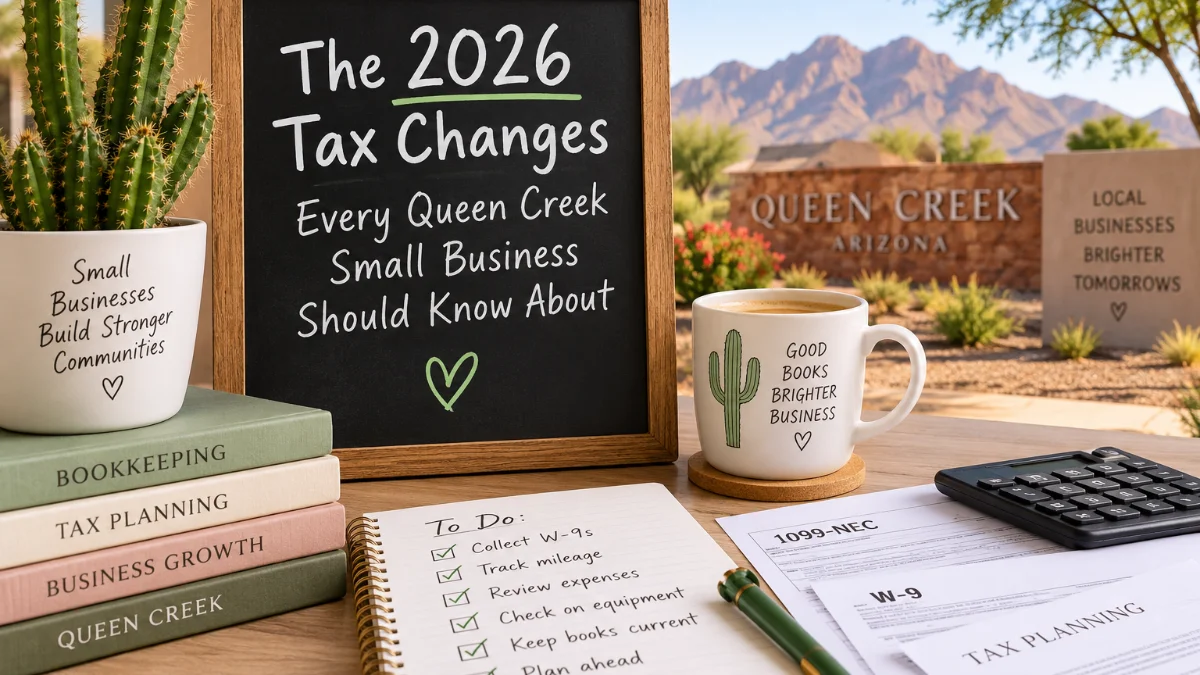

Every year, small business owners hear the same tax advice.
Keep your receipts. Track your expenses. Save money for taxes. Talk to your tax professional.
All good advice.
But if you own a small business in Queen Creek, that doesn’t really tell you what you need to pay attention to in 2026.
So let’s talk about the things that can actually affect you.
Not every tax-code change. Not 47 pages of IRS language.
Just the changes and habits I think are worth having on your radar.
And I’m going to start with contractors, because this is one of those little bookkeeping issues that can turn into a very big headache.
1. The 1099 threshold changed, but don’t stop collecting W-9s
For payments made in 2026, the federal reporting threshold for many payments reported on Form 1099-NEC increased from $600 to $2,000. Beginning in 2027, that amount is scheduled to adjust for inflation.
That sounds like good news.
And it is.
But please don’t hear “$2,000 threshold” and think, “Great. I don’t need a W-9 unless I pay someone $2,000.”
That’s exactly how you create a January problem.
My rule when it comes to contractors is simple:
Get the W-9 before you pay the contractor.
Not in December.
Not when your bookkeeper asks for it.
Not when you’re getting ready to prepare 1099s.
Before you pay them.
The IRS says that once you’ve determined someone is an independent contractor, the first step is to have that contractor complete Form W-9. That gives you the correct legal name and taxpayer identification number you may need later.
And I can tell you exactly why I feel so strongly about this.
I had a client learn this lesson the hard way. When January rolled around and it was time to prepare 1099s, we discovered they hadn’t collected W-9s from several contractors.
Suddenly, instead of simply filing the forms, they were tracking people down for legal names, addresses, and tax ID numbers.
That is not what you want to be doing when a filing deadline is staring you in the face!
Imagine trying to track down the guy who did one job for you eight months ago. Maybe he’s changed phone numbers. Maybe he isn’t responding to your emails. Maybe you don’t even remember whether the name in your bank feed is his legal business name.
Meanwhile, you’re trying to run your business.
Save yourself the headache.
Create one rule in your business: No W-9, no payment.
2. If you drive for your business, your mileage became more valuable in July
This one is especially worth knowing in Queen Creek.
The 2026 standard business mileage rate started the year at 72.5 cents per mile. Then the IRS increased it to 76 cents per mile for business miles driven from July 1 through December 31, 2026.
That midyear change makes keeping an accurate mileage log even more important.
And around Queen Creek, those miles can pile up quickly.
A trip from your office to meet a client near Queen Creek Marketplace. Another appointment down Ellsworth Road. A run over toward Ironwood or out to a client’s business near Power Road.
Do that week after week and you may be talking about a meaningful business expense.
But you need records.
Trying to reconstruct a year’s worth of driving from your calendar in January is miserable.
Use an app. Keep a mileage log. Pick whatever system you’ll actually use.
Just track it while it’s happening.
3. Buying equipment for your business may have a bigger tax impact
If you’ve been putting off a business equipment purchase, this is something to discuss with your tax professional before you buy.
Under current federal rules, 100 percent bonus depreciation was restored for most qualifying business property acquired and placed in service after January 19, 2025. That can allow qualifying businesses to deduct the full cost of certain property in the first year instead of spreading the deduction over several years.
For 2026, the Section 179 deduction limit also increased to $2.56 million, subject to the applicable rules and phaseouts.
For the average Queen Creek small business, you’re probably not buying $2.56 million worth of equipment.
But maybe you’re replacing computers.
Maybe you’re buying equipment for your landscaping company.
Maybe your growing business needs machinery, tools, or office equipment.
This is where timing matters.
Don’t buy something just because somebody tells you it’s “a write-off.” Spending $10,000 to save some amount in taxes still means you spent $10,000.
Buy what your business actually needs.
Then make sure it gets recorded correctly so your tax professional has the information needed to determine how it should be treated.
4. The 20 percent Qualified Business Income deduction didn’t disappear
This is one change that is really about something not changing.
The Qualified Business Income deduction was made permanent beginning in 2026. For eligible taxpayers, the QBI component can generally be up to 20 percent of qualified business income, although income levels, business type, wages, and other limitations can affect the deduction.
If you’re a sole proprietor, partner, or S corporation owner, this is worth discussing with your tax professional.
But here’s the bookkeeping side of it.
Your tax return is only as good as the numbers going into it.
If your books show personal expenses mixed with business expenses, duplicated transactions, uncategorized income, and a giant “Ask My Accountant” account that nobody has looked at since last summer, tax planning becomes a lot harder.
Clean books don’t guarantee a deduction.
They do make it much easier to see what is actually going on in your business.
5. Don’t wait until January to find out your books have a problem
This may be the biggest one on my list, and technically it isn’t a tax change at all.
Queen Creek business owners are busy.
We’re in a community that keeps growing. New businesses are opening. Construction seems to be everywhere. And when summer heat turns into monsoon season, the calendar somehow keeps moving whether your bookkeeping is caught up or not.
It’s very easy to tell yourself, “I’ll deal with the books next month.”
Then next month becomes three months.
Then suddenly it’s January.
Now you’re trying to remember what a $1,437 payment from last March was for.
This is why I would rather see a business owner spend 20 minutes once a month reviewing the books than spend an entire weekend trying to clean up a year’s worth of transactions.
Look at your profit and loss.
Look at your balance sheet.
Look at uncategorized transactions.
Check that your bank and credit card accounts have actually been reconciled.
And if you use contractors, look at your vendor list and make sure those W-9s are there.
Twenty minutes now can save hours later.
6. You don’t need to become a tax expert
And here’s the opinion some people in my field may not say:
I don’t think most small business owners need to know every new tax rule.
There. I said it.
You have a business to run.
If you’re running a landscaping company in Queen Creek, I would rather have you focused on taking care of your customers than spending Sunday night reading IRS publications.
If you own a salon, restaurant, construction company, retail shop, or professional service business, the same thing applies.
You should understand the basics.
You should know where your money is going.
You should know whether you’re profitable.
And you should have good records.
But you don’t need to memorize the tax code.
That’s what professionals are for.
What you do need is a bookkeeping system that gives those professionals good information.
Because there’s a huge difference between handing your tax preparer clean books and handing them twelve months of mystery transactions.
My pick for the most important thing to do in 2026
If I had to choose one thing from this entire list, it wouldn’t be mileage.
It wouldn’t be bonus depreciation.
It wouldn’t even be the QBI deduction.
I’d get your paperwork and bookkeeping habits in order before you need them.
Especially those W-9s.
The 1099 threshold may have increased, but the headache of chasing a contractor for information in January has not.
So here’s something you can do today without hiring anyone or buying anything.
Open your vendor list.
Look at every contractor you’ve paid in 2026.
Ask yourself one question:
Do I have a completed W-9 for this person?
If the answer is no, start there.
Then put a simple rule in place going forward.
Get the W-9 before you pay the contractor.
Your January self will thank you.