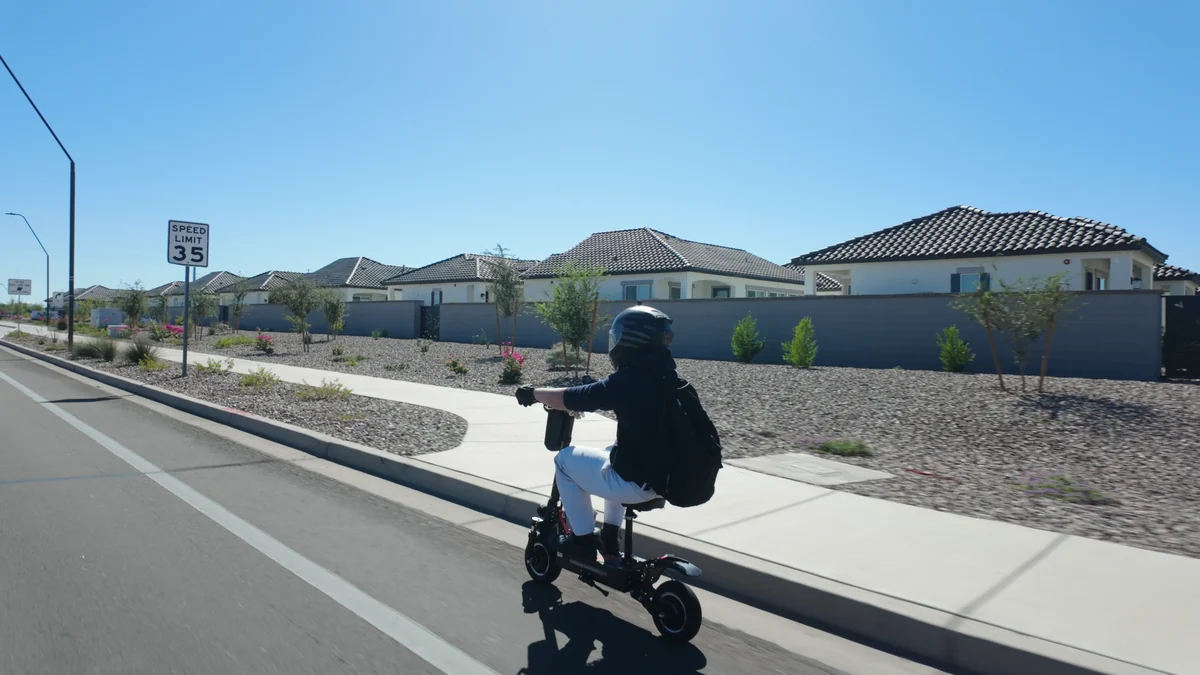
The rider above is not on an e-bike. No pedals. Under the town’s rules that one detail decides where a device can legally ride, and it’s the thing almost nobody checks before they buy.
The e-bike thing worked.
That is not the outcome most people expected when the Town Council passed an emergency ordinance back in May. Plenty of folks around town figured it was a rule nobody would enforce and nothing would change.
At the August 5 council meeting, Police Chief Randy Brice brought numbers. Queen Creek Police compared the 56 days after the ordinance took effect to the 56 days before it. Calls dropped from 250 to 165. That is a 34% drop in about two months.
The parks did even better. Calls at Mansel Carter Oasis Park fell 80%. Desert Mountain Park fell 78%. Frontier Family Park, which has always drawn the most complaints in town, fell 33%.
Brice, who has been in law enforcement 34 years, told the council he had never seen legislation “make so much difference in such a short period of time,” according to the Queen Creek Tribune.
So the rules are real and they are being enforced. Which makes it worth knowing what they actually say, because most people in town still have it slightly wrong.
What actually changed
The Council voted unanimously on May 20. Ordinance 890-26 took effect May 21. Four things changed.
E-bikes are out of town parks. Not just off the grass. Electric bikes, other power-driven mobility devices, and motor vehicles are not allowed in town parks at all, including the sidewalks inside the park. You can still use roadways, parking lots, or multi-use paths to get in and out. Once you are there, you walk it or carry it. No recreational riding, racing, stunt riding, or cruising inside the park.
15 mph. That is the limit on sidewalks, multi-use trails, parking lots, and bike lanes. It applies whether or not you see a sign. This one catches people, because it is not a blanket speed limit on e-bikes everywhere. It is tied to those specific surfaces.
Hands free. You cannot hold a phone while riding. Hands-free and voice-operated is fine. This applies to regular bicycles too.
Police can impound the device. If a rider creates a serious safety risk, the bike goes. Reckless riding, fleeing from police, blocking traffic or pedestrians, riding where it is prohibited around people or horses. The hold is a minimum of 72 hours, and the rider has to complete a QCPD safety course before it comes back. If the rider is under 18, a parent or guardian has to sit through the class too.
That last detail is the one that changed behavior. It is not a ticket that a kid can hide from you. It is a Saturday you are both spending in a classroom.
Why it happened
Complaints had roughly doubled. Calls for service involving juvenile disturbances and e-bike issues rose 94% in the first quarter of 2026 compared to the same period in 2025, from 247 calls to 478.
The pattern behind those calls was consistent. High-speed riding and wheel lifting. Riding on grass, pump tracks, courts, and plazas. Near misses with people and cars. Groups getting aggressive when somebody said something. The town’s own summary of the problem put it plainly: families were leaving public spaces and not coming back.
Mayor Julia Wheatley framed the vote as a balancing act in the town’s announcement. “The action at the May 20 meeting is in response to our resident concerns and an effort to find a balance of safety, personal responsibility and maintaining our high quality of life,” she said, noting that communities across the region are working through the same thing.
Brice was direct about what the town was and was not going after. “We are not trying to take away fun or prevent responsible riding,” he said. “But we cannot tolerate reckless behavior that puts riders, pedestrians, equestrians, families and our community at risk.”
Councilman Jeff Brown put it shorter at the August meeting. The mantra was never don’t ride. It was ride safely.
The part most parents get wrong
Here is the thing almost nobody knows until it becomes a problem.
A lot of what gets sold as an “e-bike” is not an e-bike. It is a motorcycle, legally speaking, and the rules are completely different.
Queen Creek PD spells this out on their safety page. Pedals do not make something an e-bike. Neither does the sticker on the box. A legal e-bike falls into one of three classes:
- Class 1 and Class 2. Anyone can ride. Fully operable pedals, assist up to 20 mph, motor under 750 watts.
- Class 3. Anyone can ride. Operable pedals, max assisted speed 28 mph, motor under 750 watts.
If it does not fit one of those, it is a motor-driven cycle or a motorcycle. That means the rider has to be 16 or older, needs a driver’s license with a class M endorsement, and the machine needs registration and proof of insurance. Your fourteen-year-old cannot legally ride it anywhere. Not on the street, not on the path, not in the neighborhood.
The department names the usual suspects outright: Sur-Ron Light Bee, Talaria Sting, E Ride Pro, Rawrr Mantis, Segway X260, and most electric dirt bikes without pedals.
Their quick check for parents is worth taping to the garage wall. It is probably not an e-bike if:
- It has no pedals
- It goes faster than 28 mph
- The motor is rated 750 watts or higher
- It looks like a dirt bike or a motocross bike
- The seller calls it an e-moto, an electric dirt bike, an off-road bike, or a “Sur-Ron style” bike
One more that trips people up: modifying a legal e-bike can push it out of its class. Aftermarket throttles, swapped batteries, and overridden speed limiters can turn a bike your kid was allowed to ride into one they were not.
Where each one can actually ride
Even among legal e-bikes, the class matters, and this is the detail most families miss.
Class 1 and Class 2 e-bikes can use sidewalks and multi-use trails and paths. Class 3 cannot. A Class 3 e-bike belongs on streets and in bike lanes only.
So a parent can buy a perfectly legal, perfectly street-legal Class 3 e-bike and hand it to a kid who then rides it exactly where it is not allowed, on the sidewalk to school. Nobody did anything wrong on purpose. The rule is just not obvious.
Speed limit is 15 mph on sidewalks, multi-use trails, parking lots, and bike lanes regardless of class. Pedestrians and horses have the right of way. Lights are required at night, white in front and a red light or reflector in back.
The national picture, honestly
You will see some alarming e-bike numbers floating around, so here is the real version with the timeframe attached, because the timeframe is usually what gets dropped.
The Consumer Product Safety Commission counted an estimated 155,200 emergency room visits tied to e-bikes across eight years, from 2017 through 2024. It is aware of 310 e-bike fatalities over that same eight-year span, which is 58% of all micromobility deaths it tracked.
Those are cumulative totals, not annual ones. They are still going up fast, and e-bikes are the biggest share of the category. But an eight-year total reported as a one-year total is how a real problem turns into a scary number nobody believes.
On speed, the CPSC’s 2024 study of e-bike injuries found 47% of injured riders were going under 20 mph, 15% were at 20 mph or more, and 38% did not say.
The one thing to do this week
Go look at the bike in your garage and answer one question. Does it have working pedals, and is the motor under 750 watts?
If yes, find out whether it is Class 1, 2, or 3, because that determines whether your kid can legally be on the sidewalk. It is usually printed on a sticker on the frame.
If no, or if you are not sure, Queen Creek PD will look at it for you. You can schedule an appointment to have a device inspected, or to ask about one you are thinking of buying, by emailing qcpdconnect@queencreekaz.gov. Doing that before you spend the money is a lot cheaper than doing it after.
The town also runs a free e-bike and motorized device safety class for riders and parents. It is the same class that is mandatory before an impounded bike gets released, except you get to take it on your own schedule instead of theirs. Details are on the town’s safety and education page.
To report something dangerous, QCPD’s non-emergency line is 480-358-3500. Call 911 if it is an emergency.
None of this is about being the neighborhood scold. The numbers say the parks came back. Frontier, Desert Mountain, and Mansel Carter are usable again on a Saturday morning, and that happened in about two months. Knowing which bike your kid is on is how it stays that way.
If you run a business here and want to be part of the conversations shaping this town, that is what we do. And when you need a trusted local pro, our member directory is full of Queen Creek business owners who show up.