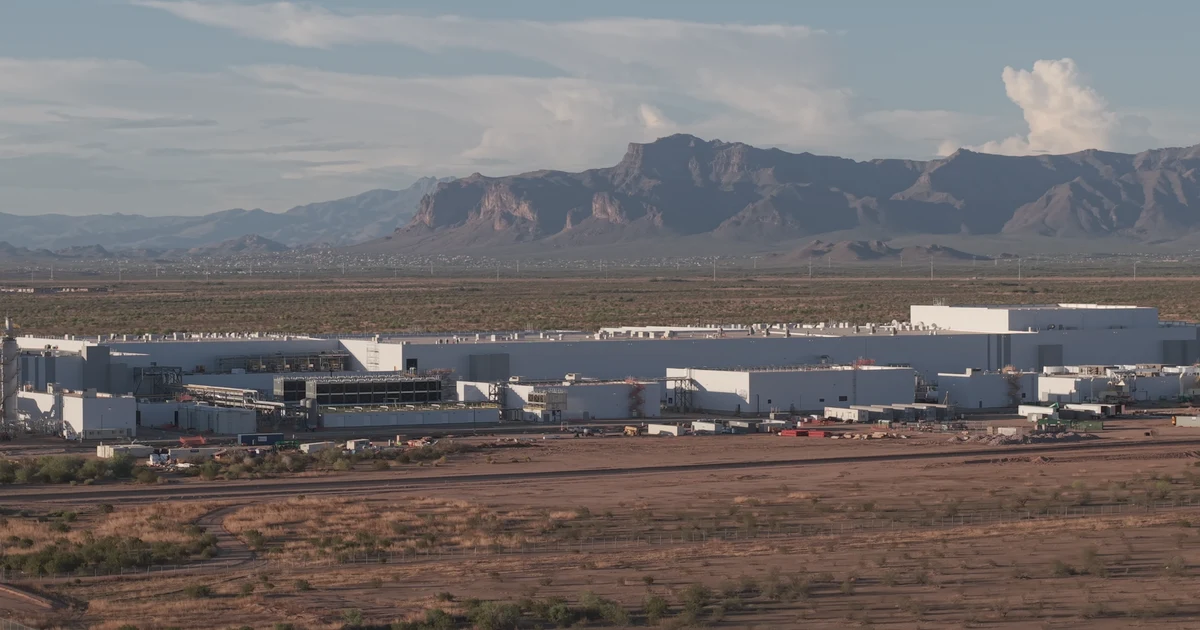
Every time the LG plant comes up on local Facebook, the same questions fill the comments. How much water will it use. Whether it is safe next to the Combs schools. Whether the jobs are real. Whether it will burn.
They are fair questions. This is a $5.5 billion battery factory going up at Ironwood and Germann, what LG bills as the largest stand-alone battery manufacturing investment in North America, and the town’s latest update says it is on track to start production in late 2026. You should be asking questions.
So we pulled the permits, the town’s own commitments, and the public record, and answered the six that come up the most. Where the honest answer is “nobody has said yet,” we say that too.
How much water will it use?
This is the question people ask most, and here is the uncomfortable truth. There is no public number. We could not find a gallons-per-day figure published by LG, the town, or the county anywhere. If you have seen a specific number in a comment section, it did not come from a source anyone can check.
Here is what is actually on the record. The town states that LG is required to secure its own water supply at its own expense, and that the facility will be net neutral on the town’s water system. Reporting in late 2024 said LG was negotiating to buy water from Salt River Project and the Gila River Indian Community, specifically so the plant would not lean on local groundwater.
So the documented answer is: not your water, purchased separately, at their cost. The legitimate open item is that the final agreement and the actual volume have not been made public. That is worth pushing on, and asking your council members for, and it is a different thing than the plant drinking Queen Creek dry.
Wastewater has a clearer answer. The plant must pre-treat everything before it touches the town sewer, the town samples for compliance at least monthly, and the town has committed to publishing those results publicly.
Is it really right next to the Combs schools?
Partly, and this deserves a precise answer because the property and the buildings are not the same thing.
The site is a full square mile, 650 acres between Germann and Pecos along Ironwood. Ranch Elementary sits near the property’s southeast corner at Kenworthy and Germann. So yes, the land touches the neighborhood. The Phase 1 factory buildings, the ones opening late 2026, sit on the far north side of that square mile along Pecos, which the town describes as nearly a mile from the nearest school.
Here is the part that is genuinely unsettled. Phase 2, a second plant for home and grid storage batteries, has been paused since mid 2024 and has no approved site plan. If it gets built, it would sit closer to the Germann side. That is the piece worth watching if the school question is your question.
And about the boundary confusion, because half the comments are some version of “isn’t this San Tan Valley?” The site is inside Queen Creek’s town limits but on the Pinal County side of town. It borders unincorporated San Tan Valley, which is why STV residents, including Combs families, never got a vote on it. That frustration is real and it is baked into how Arizona annexation works, not something anyone can fix after the fact.
What about a lithium fire?
The fires people link in the comments are real events. They are also a different kind of facility. The 2019 explosion in Surprise was a battery storage site. The big fires in Illinois and Missouri were a storage warehouse and a recycling plant. None of them were factories. A plant that manufactures cells has different risks than a warehouse packed with charged batteries, and conflating them is how a scary headline from Missouri becomes a fact about Ironwood Road.
What a factory actually deals with is solvents, dust, and materials handling. That is what the air permits Pinal County drafted for the plant and put through public comment are built around: dust collection at 99 percent efficiency, carbon absorption towers on the solvent recovery process, hard caps that keep emissions under federal major-source thresholds, county inspections, and an annual public emissions inventory. On the fire side, the town’s published commitments include sprinklers throughout, fire walls, a dedicated fire pump with on-site fire water, special encapsulant agent on regional trucks, and monthly regional hazmat training.
One honest asterisk. The cells in that Surprise storage site were made by LG Chem, this company’s former parent, though LG Chem disputed the investigation’s conclusions about the cause. The connection is not invented. The category is just wrong.
Are the jobs real, or is it robots and imported workers?
The skepticism here is earned, because the promised numbers have moved around. Early coverage said 1,500 jobs. Later coverage said 2,800. As of February 2026, about 150 people had been hired, with the big waves planned around production start.
What points toward real local jobs rather than a badge-scan ghost town: LG runs its operator training through Central Arizona College’s Superstition campus, which is a pipeline built for people who already live here, and the roles being filled are machine operators and technicians, not just office staff. And no, it is not a disguised data center. The county permit filings describe electrode coating lines, cell assembly, and solvent recovery in detail. You cannot permit a data center by accident.
Will there be a lot of automation? Yes. Every modern battery plant is heavily automated. The town still projects this becomes its largest employer by a wide margin, and if you want one anyway, hiring runs through LG Energy Solution Arizona’s postings.
Ironwood is already a nightmare. Now this?
No argument on the starting point. The corridor is rough, and we have written before about why Queen Creek traffic is what it is.
What is committed for this project specifically: Ironwood widens to three northbound lanes from Germann to the 24, new signals go in at Ironwood and Pecos and a half mile north of Germann, and Pecos gets built new from Ironwood to Kenworthy. Whether that keeps up with a plant’s shift changes plus the neighborhoods still going in is a fair thing to doubt. But “they did nothing about traffic” is not accurate.
Wasn’t that supposed to stay public land?
This one comes from a real place, but it mixes up two kinds of public. The site was Arizona State Trust land. Trust land is not parkland and was never promised to stay open. It exists to be sold or leased to make money for its beneficiaries, and those beneficiaries are mostly Arizona’s public schools. The $84 million LG’s partner paid at auction went into that trust.
You can dislike what got built and still know the sale was the land doing exactly what trust land legally exists to do. If anything, the irony cuts the other way: the land next to the schools was sold, in part, to fund schools.
What to actually watch
If you want to hold this project accountable, these are the real levers. Watch the air permits: the drafts went through public comment in 2024, and the final versions and any compliance history are public records at Pinal County Air Quality. Watch for the town to publish the wastewater sampling results it promised. Watch what happens with Phase 2’s site plan, because that is the school-proximity decision that has not been made yet. And ask the town to make the water agreement public when it is final.
That is the whole point of asking good questions. Not to win a comment thread, but to know which documents to read when they land.