
Every marketing “expert” hands you the same list. Post more. Use the right hashtags. Get on every platform. Stay consistent. Be authentic.
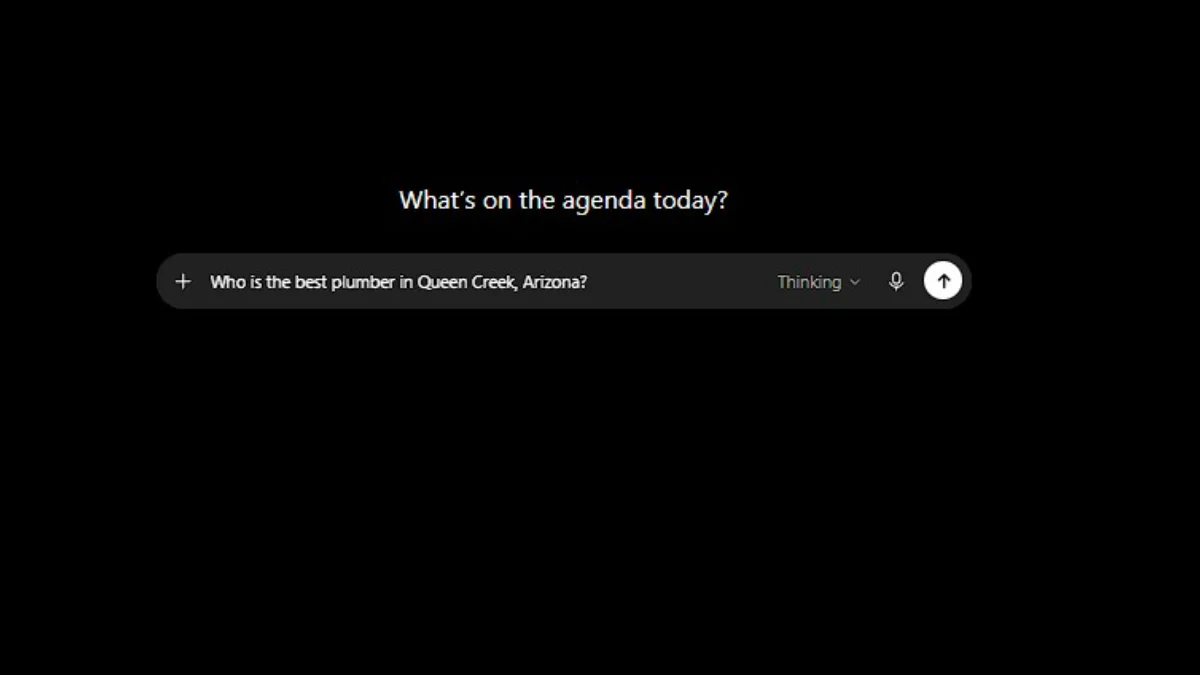
Okay. None of that tells you how a customer typing “best plumber in Queen Creek” into ChatGPT ends up hearing your name.
That is the real question. Not “how do I get more likes.” It is “how do I become the answer when a real person asks a machine for a recommendation.”
So here is the version I actually use with clients. Not the recycled blog you have read six times already.
First, a number that should get your attention. Last year, about 6 out of 100 people used an AI tool to find a local business. This year that jumped to 45 out of 100. AI is now the third most-used way people discover local businesses, behind only Google and Facebook, and it already passed Yelp. Your customers are already doing this. The 30 to 44 year old homeowner calling you about a water heater? They are the heaviest users of the bunch.
Here is the part nobody tells you. Ranking well on Google does not mean the AI will name you. There is only about a 45% overlap between businesses that win the Google map pack and businesses that show up in AI answers. More than half the companies sitting pretty in Google are invisible when someone asks ChatGPT the same question.
And the AI does not give a list of ten. It names three or four businesses and stops. You are in the answer or you do not exist. There is no page two to scroll to.
So how do you become one of the names it says out loud? Here is the list.
- Turn your website into the answer, not the brochure Most Queen Creek business websites read like a pamphlet. “We are family owned. We care about quality. Call today.”
An AI cannot recommend that. There is nothing in it to grab.
The AI is looking for pages that answer the exact question a customer would ask. “How much does it cost to fix a slab leak in Queen Creek?” “Why does my breaker keep tripping during monsoon season?” “Do you service homes out in San Tan Valley on a septic system?”
Every service you offer needs its own page. Real detail. What you do, where you do it, what it costs, what to expect. Then add a short FAQ at the bottom of each page answering the questions you already hear on every call.
You know those questions. You answer them ten times a week on the phone. Put them on the page. 2. Fix your listings everywhere, not just Google This is the one most people miss, and it is a big one.
Everybody obsesses over their Google Business Profile. Fine, go finish it. But ChatGPT does not start with Google. When researchers traced where ChatGPT pulls its first local picks from, roughly 60 to 70% came from Foursquare’s Places API, not Google.
Foursquare. The thing you last thought about in 2014.
Your listings on Foursquare, Apple Maps, and Yelp, and how consistent your name, address, and phone number are across all of them, now feed AI recommendations directly.
If your business shows up as “AJ’s Plumbing” on one site, “AJ Plumbing LLC” on another, and an old cell number on a third, the AI cannot merge those into one confident business. So it skips you and names the shop with clean listings.
Spend an afternoon making every listing match. Same name. Same address. Same number. It is boring. It works. 3. Get reviews with actual words in them You already know reviews matter. Here is what changed.
AI reads the text of your reviews, not just the star count. It looks for patterns in what people actually say.
So a five star review that says “great service, thanks” does almost nothing. A review that says “fixed our slab leak in the Cortina neighborhood the same day, walked us through the whole thing, fair price” is gold. It tells the AI what you do, where you do it, and that people trust you.
When you ask a happy customer for a review, nudge them. “Would you mind mentioning what we fixed and how it went?” That one sentence changes what the machine learns about you.
And reply to every review. Even the good ones. It shows you are active and paying attention. 4. Write pages for the real Queen Creek problems This is where local knowledge beats any generic checklist.
Our ground out here is full of caliche. That rock-hard calcium layer under the dirt that eats trenching equipment and turns a simple line repair into a real job. A plumber in San Tan Valley who has a page explaining what caliche does to your water line, and why a repair here is not the same as a repair in Phoenix, is speaking the customer’s language. The AI notices that specificity.
Same for electricians and monsoon season. Every July the storms roll in, the lightning hits, and the surge calls start. A page about protecting your panel during monsoon, or why your breaker trips when the dust storm knocks the power out and back on, answers a question people are literally typing in that week.
Then there is the split in our town. Half of Queen Creek is brand new. Ironwood Crossing, Encanterra, Church Farm, all built in the last few years. The other half is older farm and ranch property near the original town core along Ellsworth and Rittenhouse, some on wells, some on septic. A plumber who has separate pages for “new build” issues and “older well and septic” issues covers both customers. Most of your competitors have one generic page for the whole valley.
The point is not to sound local. It is to be genuinely useful to the person searching. The AI rewards the business that actually answers the question. 5. Blog like you are answering a customer at the counter Forget keyword stuffing. That game is over.
The businesses winning right now are the ones honestly explaining their work, answering real concerns, and educating people before they buy. Not the ones cranking out generic filler.
Coffee shop owners, this is your lane too. A post like “where to grab coffee near the Queen Creek Marketplace before the Farmers Market at Schnepf Farms” is exactly the kind of thing someone asks an AI on a Saturday morning. Write the answer. Be helpful. Mention the real spots and streets.
Write the way you would explain something to a customer standing in front of you. Short. Honest. Specific. 6. Fix your schema so the machine can read you Schema is just code on your site that labels what things are. This is your business name. This is your address. This is a FAQ. This is a review.
You cannot see it. Neither can your customer. But the AI reads it first.
Adding LocalBusiness schema that matches your current information helps AI tools trust and quote your details correctly. When your FAQ is marked up properly in the code, the AI can grab it and use it as the answer.
This is the one part where you probably want a hand from someone who does it every day. But it is not magic. It is labeling. The story that made me a believer I had a client over in Gilbert running a Wix site. Nice business. Basically invisible in AI search.
We did not rebuild anything. We went through the site and made a short list of fixes.
We added FAQ sections to each page answering the questions her customers actually asked. We cleaned up her images so they loaded fast and were labeled right. We corrected the schema on her pages so it included those new FAQs, which meant the code was finally telling the machines what was on the page.
Then we had her ask her real clients for reviews, the kind with actual words in them. And we published a few solid blog posts that answered real questions in her field.
That was it. No new website. No huge budget.
Within a couple of months she started showing up in AI searches. Her website traffic climbed every single month after that. Real people, finding her through the exact tool everyone is worried about.
None of those steps were fancy. They were just done in the right order, on purpose. The thing most people in my field will not say out loud Ready?
This is not hard.
Everybody wants you to believe it takes some secret sauce and a five figure retainer. It does not. It is a time-consuming task that most business owners simply do not want to sit down and do.
That is the whole gap. Not skill. Not money. Just the willingness to spend the hours fixing listings, writing FAQ pages, cleaning up schema, and chasing reviews.
Make the right improvements in the right spots, and you can make real gains in getting found by AI. I have watched it happen with a Wix site and an afternoon of cleanup.
And here is the honest part. We are at the very beginning of this. The rules are still being written. What works today might shift in six months when Google or OpenAI changes something. So the businesses that stay curious and keep adjusting are the ones who will own their category out here while everyone else is still arguing about hashtags. My honest pick if you only do one thing Build the pages that answer the exact questions your customers ask, and mark them up so the machine can read them.
Reviews and listings matter. But if you make your website the clearest answer to “how do I fix this problem in Queen Creek,” you have done the heavy lifting. Everything else stacks on top of that. What to do this week, for free Open ChatGPT or Google’s AI answers right now. Ask it: “Who is the best [your trade] in Queen Creek, Arizona?”
Read what it says. Are you named? Who is? What did the AI say about them?
That answer is your real competition in 2026. It probably looks different from your Google rankings. Five minutes, no cost, and you will know exactly where you stand before you change a single thing.
Start there. Then fix the pages.
QC EDGE is an entrepreneur mastermind for Queen Creek business owners. We meet the first and third Thursday of every month at 8:30 AM to work through exactly this kind of thing together.